Table of Contents
Most problems in the first week after school opens could have been fixed a month earlier. A class list that was never finalized. A teacher booked in two rooms at the same time. A fee notice sent with last year’s amounts. A new family that never got the start date.
These are easy to fix in August. They are hard to fix when hundreds of students are already in the building.
This new academic year school preparation checklist is built around one idea: do things in the right order. You cannot build a good timetable before you know your classes and teachers. You cannot know your classes until student records are ready. So the plan below starts early and moves step by step, from about 12 weeks before school starts to the end of the first week after it opens.
Every school calendar is different. Use the week numbers as a guide, not a rule. If your break is short, squeeze the steps together.
The six areas to prepare
Almost everything you need to do fits into one of these areas:
- Calendar and rules: term dates, holidays, exam dates and any deadlines from your education authority.
- Student records and admissions: who is enrolled, and in which class and section.
- Staff: who teaches what, and who is new.
- Timetable, rooms and supplies: the weekly schedule, classrooms, books and equipment.
- Fees: fee amounts, invoice dates and payment methods.
- Communication: what parents, students and staff need to know, and when.
The order matters: calendar first, then records, then staff, then timetable. Parent messages and fee invoices come last, because they depend on everything before them.
One note on legal rules. Requirements such as safety checks, fire inspections, enrollment reports and health forms are different in every country, and sometimes in every region. Check them with your own authority and add those dates to your calendar first. This guide stays general on purpose.
8–12 weeks before school starts: make the big decisions
This stage is about deciding, not doing. Every decision you make now saves you many small questions later.
Fix the academic calendar. Confirm term dates, holidays, parent meetings and exam periods. Most other deadlines depend on these dates.
Look back at last year. Ask your team three questions: What slowed us down at the start of the year? What did parents complain about most? Which manual task took the most time? The answers show you where to focus.
Decide how many sections each grade will have. Base this on students moving up, expected new admissions and room space. This number affects staffing, the timetable and fee planning, so be careful and realistic.
Start the staffing conversation. List open positions and planned leave. If you need to hire, start now. Hiring in August usually forces compromises in the timetable.
Approve the fee structure. Decide whether fees are changing and get approval before you create any invoices. Changing fees after invoices go out creates a lot of extra work.
Check what expires. Software renewals, hosting, domain names and device warranties can all run out during the year. It is boring work, but it prevents an unpleasant surprise in week two.
4–6 weeks before school starts: get records, staff and schedules ready
The big decisions are made. Now turn them into clean, accurate information.
Student records and admissions
Correct class lists are the base for everything else, so get them right.
- Set a cutoff date for admissions. After that date, new applications go to the next intake or are marked as late. Without a cutoff, your class lists keep changing while you build the timetable.
- Finish pending applications and document checks. Missing transfer certificates, birth documents and health forms are much easier to collect now than at the school gate. If you take applications online, a system that shows each applicant’s status makes this faster. CodeClove’s guide to running an online school admission pipeline in WordPress shows one way to set that up.
- Move students up to their new classes. This is the biggest records task of the year. Decide who moves up, who repeats a year and who has left, and write down the reason. If you use a school management system, make sure the new academic session exists and that last year’s grades, attendance and fee history are kept. In School Management Pro, for example, year-end promotion creates new enrollments in the new session and leaves the old session’s records untouched.
- Update contact details. Wrong phone numbers and old email addresses are a common reason parents miss important messages. Ask families to confirm their details when they re-enroll, not during an emergency.
- Moving to a new system? Do it now, not during term. A good migration takes weeks. Before you upload any data in bulk, read about how to import student data into a school management system so you can catch duplicate or incorrect records early.
Staff
- Publish who teaches what. Share subjects, classes, class teacher roles and duty rosters. Check each teacher’s weekly load against your own policy.
- Plan for substitutes. Teachers will be absent in the first month. Decide in advance who covers, how cover is requested and how it is announced.
- Prepare new staff. A short guide to the daily routine, attendance and grading steps, safeguarding contacts and who to ask for what is more useful than a long presentation. Give each new teacher a named colleague to ask for help.
- Book required training. Safeguarding, first aid, fire drills and data protection all need dates. Book them before teachers’ calendars fill up.
- Write down changes in responsibility. If duties moved from one person to another, say so clearly. Otherwise two people may both think they own attendance, or nobody does.
Timetable, classrooms and supplies
Start the timetable only after sections and teacher assignments are settled. If you start earlier, you will have to rebuild it.
- Draft the master timetable. Place fixed items first: shared labs, sports halls, part-time teachers and anyone who works across sections.
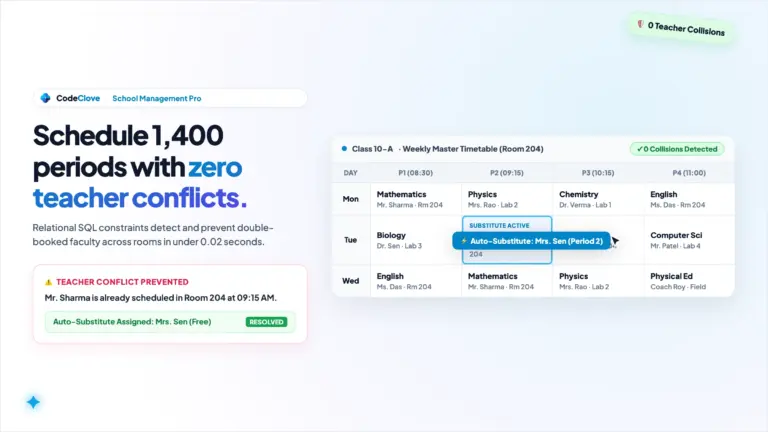
- Check for clashes. Look for a teacher, room or class booked twice before you publish. Spreadsheets make this slow and easy to get wrong. A system that blocks a double booking the moment you save it removes the problem completely. CodeClove has a step-by-step guide to building a conflict-free school timetable in WordPress if you want to see how.
- Assign rooms. Check capacity against real section sizes, not planned ones.
- Order supplies. Textbooks, stationery, lab materials and sports kit. Compare against what you already have so you order only what is missing.
- Inspect the building and IT. Check furniture, projectors, printers, Wi-Fi, labs and library systems. Create accounts for new students and staff.
1–2 weeks before school starts: test and communicate
The goal of this stage is to find the last problems while you can still fix them.
Publish the final timetable and class lists. Send them to staff first. Once staff confirm everything is correct, send them to parents. Set a date after which changes are made by request only.
Send one clear message to parents. One well-organized message is better than five partial ones. Include:
- the first-day date, start and finish times, and drop-off and pick-up arrangements;
- uniform and supply requirements;
- the fee schedule and accepted payment methods;
- who to contact for which question;
- how to report a student’s absence;
- anything that has changed since last year, such as policies, staff or transport.
If parents use a portal for attendance, schedules or invoices, send login details and ask someone outside the office team to test them.
Send the first fee invoices. Create them only after the fee structure is approved and class lists are final. Check a few sample invoices first, including ones with discounts and siblings, before sending the full batch.
Do a full practice day. Walk through the first day the way a student would: arrival, registration, the first few lessons, break and going home. Test the bell, signs, attendance tool, lunch arrangements and pick-up point. Practice one emergency procedure so new staff know what to do.
Give teachers a first-week pack. Include class lists with emergency contacts and medical notes, the timetable, room details, attendance instructions and the schedule for assemblies and orientation.
The first week after school opens: watch, fix and learn
Preparation does not stop on opening day. The first week is the real test, so keep checking and fixing.
- Take attendance from day one. Follow up on unexplained absences the same day. This also helps you spot students who were admitted but never showed up.
- Hold a quick daily meeting. Fifteen minutes with the leadership team. Ask three things: What went wrong? What confused people? What needs a decision today?
- Keep a change log. Record every change to the timetable, rooms and staff, and tell everyone affected.
- Collect missing documents. Follow up with students who arrived late or whose records were incomplete.
- Ask for feedback. New students, new parents and new teachers notice things that everyone else has stopped seeing.
- Review at the end of the week. Write down what you would do differently next year. That note becomes the start of next year’s checklist.
Common mistakes to avoid
- Building the timetable before the student numbers are final. Late admissions and withdrawals force you to redo it.
- Treating records as a small admin job. Wrong class lists cause problems in timetables, invoices, attendance and reports.
- Telling parents too late. Parents handle a change announced three weeks ahead far better than one announced the night before.
- Skipping new staff training. A new teacher who does not know the attendance process creates avoidable data errors.
- Skipping the practice day. Problems with signs, bells, systems or arrival flow are easy to find in a practice run and hard to fix on the day.
- Changing approved decisions late. Fee amounts, section numbers and calendar dates cause the most rework when they change.
Printable new academic year checklist
Use this table as your working plan. Change the timing to suit your calendar and add any legal items for your country.
| When | Task | Owner | Done |
|---|---|---|---|
| 8–12 weeks before | Confirm academic calendar and key dates | Principal | ☐ |
| 8–12 weeks before | Review last year and note lessons | Leadership team | ☐ |
| 8–12 weeks before | Set section plan and enrollment targets | Principal / Admissions | ☐ |
| 8–12 weeks before | List open positions and start hiring | Principal / HR | ☐ |
| 8–12 weeks before | Approve fee structure for the new year | Principal / Accounts | ☐ |
| 8–12 weeks before | Check software, hosting and licence renewals | Admin / IT | ☐ |
| 4–6 weeks before | Close final admission round and finish pending applications | Admissions | ☐ |
| 4–6 weeks before | Complete promotion, repeat and leaver records | Registrar | ☐ |
| 4–6 weeks before | Confirm parent and guardian contact details | Office | ☐ |
| 4–6 weeks before | Publish teacher assignments and duty rosters | Principal | ☐ |
| 4–6 weeks before | Book training and prepare new staff | Leadership team | ☐ |
| 4–6 weeks before | Build the timetable and check for clashes | Academic coordinator | ☐ |
| 4–6 weeks before | Assign rooms and check capacity | Academic coordinator | ☐ |
| 4–6 weeks before | Order and count books and supplies | Admin | ☐ |
| 4–6 weeks before | Inspect building, IT and labs | Admin / IT | ☐ |
| 1–2 weeks before | Publish final timetable and class lists | Academic coordinator | ☐ |
| 1–2 weeks before | Send start-of-year message to parents | Office | ☐ |
| 1–2 weeks before | Check and send first-term invoices | Accounts | ☐ |
| 1–2 weeks before | Test parent and student portal logins | IT | ☐ |
| 1–2 weeks before | Do a full practice day and one emergency drill | Leadership team | ☐ |
| 1–2 weeks before | Give teachers their first-week pack | Academic coordinator | ☐ |
| First week after opening | Take attendance and follow up daily | Class teachers | ☐ |
| First week after opening | Hold a daily leadership meeting | Principal | ☐ |
| First week after opening | Keep a log of all changes | Office | ☐ |
| First week after opening | Collect missing documents | Registrar | ☐ |
| First week after opening | Gather feedback and note lessons | Principal | ☐ |
Frequently asked questions
How early should a school start preparing?
Start decisions about the calendar, student numbers and staffing about 8 to 12 weeks before school begins. Smaller schools can start later. But anything that involves hiring, changing systems or changing fees needs more time.
What if admissions are still open close to the start date?
Set a cutoff date for the class lists you use to build the timetable. After that, place late students in existing sections where there is space. Change the timetable only if you truly need a new section. Without a cutoff, the schedule never settles.
Who should own the checklist?
One person should own the whole plan, usually the principal or a deputy. Each task should also have its own named owner. A checklist that everyone shares often ends up with no owner at all.
Conclusion
Good preparation is not about doing more work. It is about doing the same work in an order that avoids doing it twice. Fix the calendar, then records, then people, then the timetable, then the messages that depend on all of them.
If you do only one thing from this guide, pick a date after which class lists are frozen for timetable building, and plan backwards from it. Then print the checklist, give every line an owner and book your first planning meeting this week.