Table of Contents
Your school’s data is more sensitive than you think
A school database is not an ordinary customer email list. It holds records that parents and students expect to keep private for life. Student birth dates, national identity numbers, home addresses, and emergency guardian contacts. Medical files that document severe peanut allergies, prescription schedules, and clinical ADHD assessments. Behavioral incident reports, suspension histories, and guidance counselor notes. Financial hardship applications submitted by parents requesting tuition fee concessions.
When an institution signs up for a multi-tenant cloud platform like Classter, Fedena, MySchool, or Gradelink, that data leaves the building. It sits on remote servers owned and operated by an outside vendor. Support representatives have database access. Their engineers control the backup routines and patch cadences. If that company changes pricing, gets acquired by private equity, or pivots its product roadmap, school administrators have virtually zero leverage.
Most school leaders accept this trade-off without a second thought. They choose SaaS because signup is quick and the vendor promises enterprise security. In practice, that convenience offloads core data custody to third parties while leaving the legal and moral liability squarely on the school.
What schools actually store (and why it matters)
Consider the exact categories living in a day-to-day school management system:
Student personal identity
Legal names, dates of birth, home addresses, nationality, social security or Aadhaar numbers, and passport scans for international exchange students. An accidental leak exposes children to identity theft before they even open their first bank account.
Medical and psychological records
Life-threatening allergies, medication administration logs, vaccination histories, IEP (Individualized Education Program) evaluations, and confidential counselor notes. In most legal jurisdictions, these documents carry the same statutory confidentiality rules as hospital patient charts.
Family and custody situations
Parent contact details, workplace information, income declarations for financial aid, divorce decrees, and active restraining orders. Schools often know more about private domestic disputes than local courts. Exposing a home address or an unauthorized contact can create an immediate physical safety hazard for a child.
Financial ledgers and fee collections
Tuition invoice ledgers, bank account details for fee refunds, scholarship awards, and records of families struggling with overdue tuition. These records reveal family financial distress that belongs nowhere near an external marketing or analytics pipeline.
Disciplinary and behavioral records
Formal incident reports, bullying investigations, suspension notices, and internal teacher observations. These files can follow students for years, influencing secondary school admissions and university recommendations.
Every single category here carries regulatory exposure. When you hand those records to an external cloud vendor, you rely entirely on their internal safeguards. You need that protection today, and you need it ten years from now while those archives remain on their disks.
School privacy regulations carry severe penalties
Three regulatory frameworks establish strict legal boundaries for student data storage:
FERPA (United States)
The Family Educational Rights and Privacy Act (FERPA) applies to every American educational institution that receives federal funding. FERPA gives parents direct inspection rights over education records and forbids non-consensual disclosures. When a school employs a SaaS provider, that vendor qualifies only under the narrow “school official” exception. Under that rule, the institution must maintain direct control over how student records are maintained, used, and audited.
If a cloud provider shares metadata, trains internal algorithmic models on student work, or fails to expunge records after contract termination, the school itself commits the regulatory infraction.
GDPR (European Union and UK)
The General Data Protection Regulation (GDPR) classifies the school as the data controller and the SaaS provider as a data processor. Under Article 28, schools must enforce rigorous data processing agreements and ensure personal data remains within compliant legal jurisdictions.
Many commercial school software providers maintain primary server infrastructure in the United States. For British or European schools, storing pupil records on American cloud nodes creates an international data transfer. Following the Schrems II decision that struck down Privacy Shield, relying on generic vendor terms leaves schools open to regulatory audits and heavy statutory fines.
India’s DPDP Act
Section 9 of India’s Digital Personal Data Protection Act, 2023 imposes strict statutory duties on data fiduciaries processing children’s personal data. Schools must obtain verifiable parental consent before processing student records. The law imposes an outright ban on tracking, behavioral monitoring, and targeted advertising directed at minors. When a school routes student records through SaaS tools that load third-party trackers, the institution faces direct regulatory penalties.
What happens when a SaaS vendor suffers a breach
Security failures at education technology vendors happen regularly across the industry.
In 2022, Illuminate Education suffered a breach that exposed demographic, academic, and special-education records belonging to millions of students. In 2025, that breach culminated in a multistate Attorney General and FTC settlement confirming that plaintext records of 1.7 million New York students sat exposed because of unpatched administrative systems. In 2020, ransomware struck Blackbaud, exposing school donor rolls and student profiles globally. In early 2025, PowerSchool disclosed unauthorized administrative access that exposed student records across multiple school districts.
When an external vendor suffers an intrusion, school administrators have no real options:
- You discover the security incident weeks or months after intruders breached the perimeter.
- You cannot review access logs or assess the blast radius on your own terms.
- You cannot patch the vulnerable software endpoints yourself.
- You have to send humiliating letters to parents explaining that an unfamiliar software firm lost their children’s records, while waiting for that vendor’s public relations team to issue scripted statements.
Self-hosting changes the equation. You control the operating environment. You pick the cloud host, configure local firewall rules, automate daily encrypted offsite backups, and isolate student records in dedicated relational tables on your own infrastructure (as detailed in our WordPress attendance tracking architecture guide). If an unexpected log event occurs, your team investigates the server immediately without waiting in a vendor support queue.
The cost argument is even more one-sided than you think
SaaS platforms charge recurring subscription fees calculated per student, per month. When you calculate cumulative school SaaS fees across multiple academic sessions, the financial math turns indefensible.
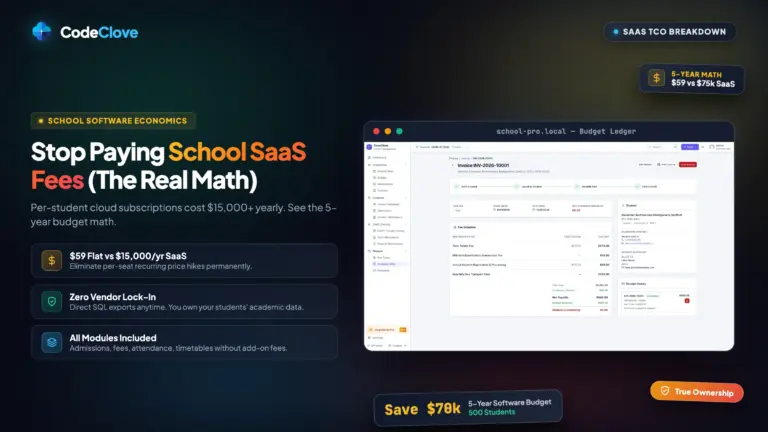
Standard SaaS platforms charge between $6 and $15 per student every month. Even at a conservative baseline of $8 per student per month, look at what schools spend over a five-year window compared to running a self-hosted WordPress system with CodeClove School Management Pro:
| Institution Tier | Student Count | Annual SaaS Cost ($8/mo) | 5-Year SaaS Total | CodeClove Pro + Cloud VPS (Year 1) | 5-Year Self-Hosted Total | 5-Year Cumulative Savings |
|---|---|---|---|---|---|---|
| Small School | 200 | $19,200/yr | $96,000 | $179 ($59 license + $10/mo) | $895 ($179/yr × 5) | $95,105 |
| Medium School | 500 | $48,000/yr | $240,000 | $239 ($59 license + $15/mo) | $1,195 ($239/yr × 5) | $238,805 |
| Large / Multi-Campus | 2,000 | $192,000/yr | $960,000 | $419 ($59 license + $30/mo) | $2,095 ($419/yr × 5) | $957,905 |
These calculations assume the school renews its CodeClove Pro license every single year for updates and priority engineering support, and runs on dedicated managed cloud hosting. If an institution operates multi-campus sites, CodeClove offers a 5-site license for $109 per year and an unlimited site license for $179 per year. Even at the highest tier, the five-year cumulative savings for a 2,000-student school exceed $950,000.
Consider what that money buys in education. A medium-sized school spending $48,000 every year on SaaS gives away the equivalent of an experienced teacher salary or an entire STEM lab renovation. High-performance cloud hosting capable of powering a school database costs $10 to $30 per month on managed providers like Cloudways or DigitalOcean. CodeClove School Management Pro costs $59 per year. Your maintenance runs on the exact same WordPress installation that powers your public school site. For a comprehensive budget breakdown, read our guide on why schools should stop paying per-student SaaS fees.
The vendor lock-in problem
Leaving a hosted platform is difficult by design. After three academic years on a vendor system, your school has accumulated thousands of student profiles, years of fee receipts, daily attendance ledgers, timetable configurations, and disciplinary notes.
Try exporting that history. Most SaaS vendors provide basic CSV exports that dump names and contact numbers while omitting payment transaction details, teacher observations, and historical audit logs. Uploaded birth certificates, ID photos, and transfer documents frequently stay trapped in proprietary file stores. Some vendors charge manual data extraction fees to return records that belonged to the school in the first place.
When your records live inside a self-hosted WordPress installation, lock-in vanishes:
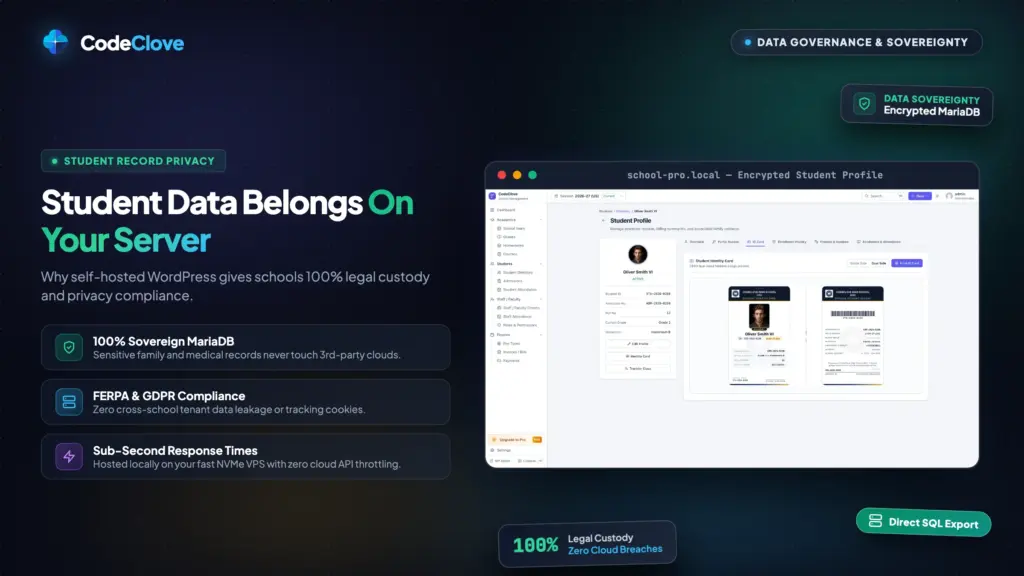
- All records live in cleanly structured MySQL tables, such as wp_codeclove_students, wp_codeclove_invoices, and wp_codeclove_attendance_records.
- You can inspect, query, export, or back up every database table through standard tools like phpMyAdmin or WP-CLI whenever you want.
- Uploaded application documents remain in your server filesystem under your direct custody.
- If you ever decide to change tools, your historical data stays on your server without vendor permission, export fees, or missing archives.
Common objections, addressed honestly
“We do not have internal IT staff to manage a server”
You do not need a systems administrator. Managed WordPress cloud hosts handle Linux operating system patches, SSL certificate renewals, automated daily snapshots, and firewall rules. If your administrative staff knows how to update WordPress plugins and add pages, they know how to run CodeClove.
“SaaS is more secure because vendors have dedicated security teams”
Centralized cloud vendors are massive targets. When attackers breach an edtech vendor like Illuminate or Blackbaud, they harvest data on millions of families in one stroke. A self-hosted WordPress instance running on an isolated server presents virtually no attack surface to automated mass credential stuffers. Combine a reputable managed host with two-factor authentication, regular updates, and strict role permissions, and your real-world exposure drops significantly below that of a multi-tenant target.
“What about uptime and reliability?”
Managed WordPress hosts provide 99.9% uptime service level agreements. School software does not demand the infrastructure of a streaming platform or a banking exchange. It experiences a predictable daily rhythm: morning roll call, occasional schedule checks, and afternoon dismissals for several hundred concurrent users. A $15 per month cloud server handles that traffic without strain.
“Will we lose features compared to a dedicated SaaS platform?”
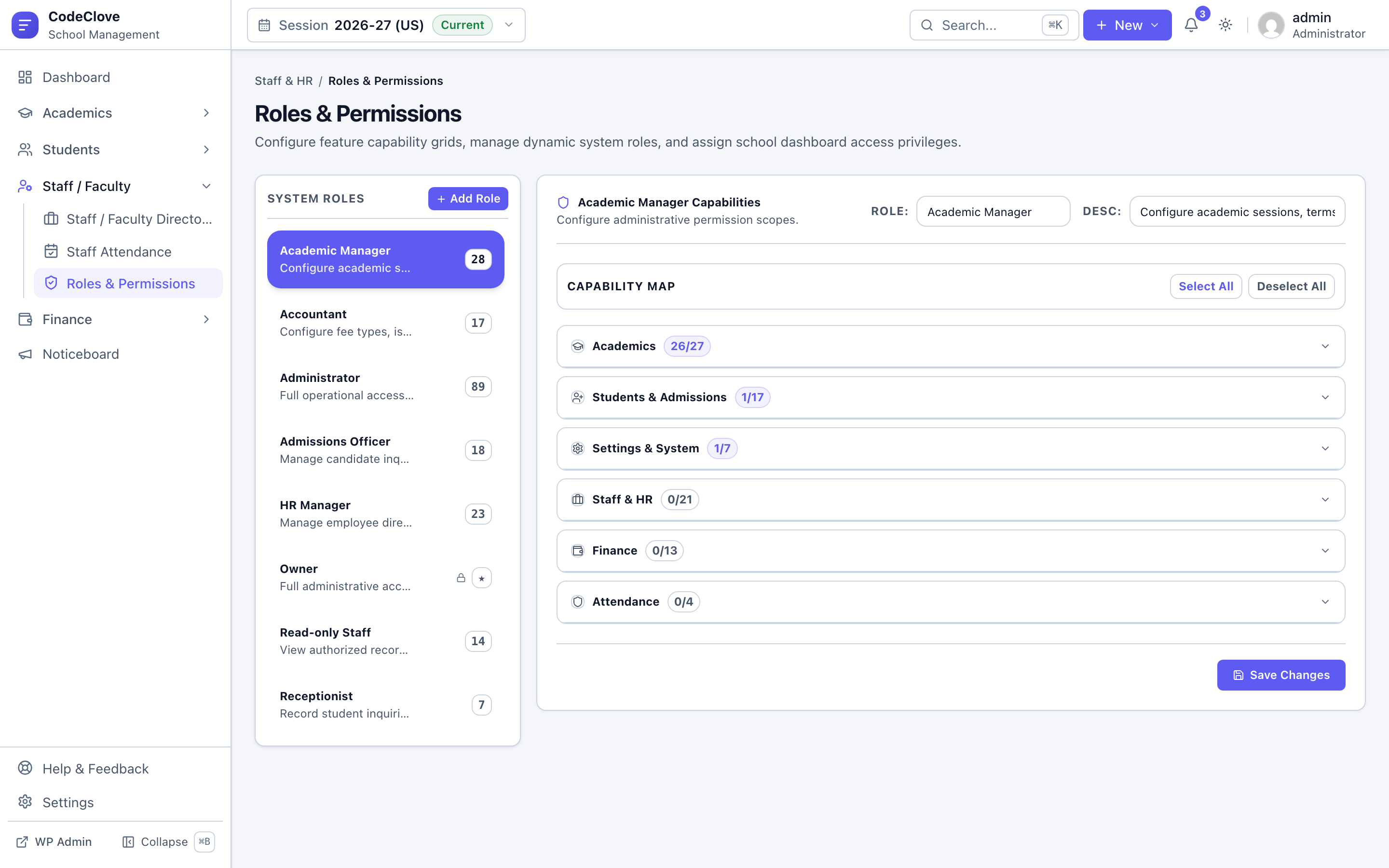
That depends on what you actually use. If you need machine learning models that generate automated behavioral predictions, an enterprise SaaS platform may have specialized features. But if you need admissions workflows via [codeclove_admission_form], student and guardian directories, timetable builders with teacher substitution conflict detection, daily roll call registers, fee invoicing with online gateways (Stripe, PayPal, Razorpay, and Indian UPI), automated SMS parent notifications (Twilio, Vonage, Fast2SMS, MSG91), and self-service parent portals via [codeclove_portal], CodeClove School Management Pro handles every workflow. Most schools pay for enterprise catalogs where 80% of the tools go untouched.
Frequently asked questions about self-hosted school data privacy
Is self-hosted WordPress compliant with FERPA and GDPR for school records?
Yes. Self-hosted WordPress gives schools complete data custody. By eliminating third-party processors, enforcing TLS 1.3 encryption, and restricting administrative role permissions, schools satisfy FERPA and GDPR standards without relying on unverified vendor claims.
What happens to student records if we change our web hosting provider?
You keep complete data portability. Because your data lives in standard MySQL database tables and WordPress upload directories, you can migrate or restore the entire database to any server at any time without vendor approval or export fees.
How do self-hosted institutions protect against ransomware and data loss?
Configure automated offsite backups, such as daily encrypted Amazon S3 or Cloudflare R2 snapshots, enforce two-factor authentication on all administrative accounts, enable a Web Application Firewall, and apply least-privilege database user permissions.
The bottom line
Student records require strict privacy protections. SaaS providers add recurring costs and third-party liabilities that schools accept out of convenience rather than practical necessity.
Self-hosting your school data on WordPress provides absolute ownership, strict security, and massive budget savings. The operational bar is low. If your team can run a WordPress website, you can run a self-hosted school management system.
Get CodeClove School Management Pro for $59 and keep your student data where it belongs: on your own server, under your own control.