Table of Contents
Most school management plugins assume you run an American school
Try installing an average WordPress school management plugin on a website for a CBSE or ICSE school. The plugin calls student cohorts “Grades” instead of “Classes.” It assumes semesters instead of three-term academic sessions. Currency defaults to USD. For automated messaging, the options boil down to Twilio and Vonage. Neither service offers affordable routing for sending 3,000 bilingual alerts to parents in India each week.
Indian schools run on distinct operational patterns. The classroom labels are different. Fee schedules rely on itemized quarterly installments and distance slabs rather than lump-sum semesters. State educational rules demand specific record-keeping. Parents expect alerts on local SMS channels and expect to pay school fees over UPI apps on their mobile phones.
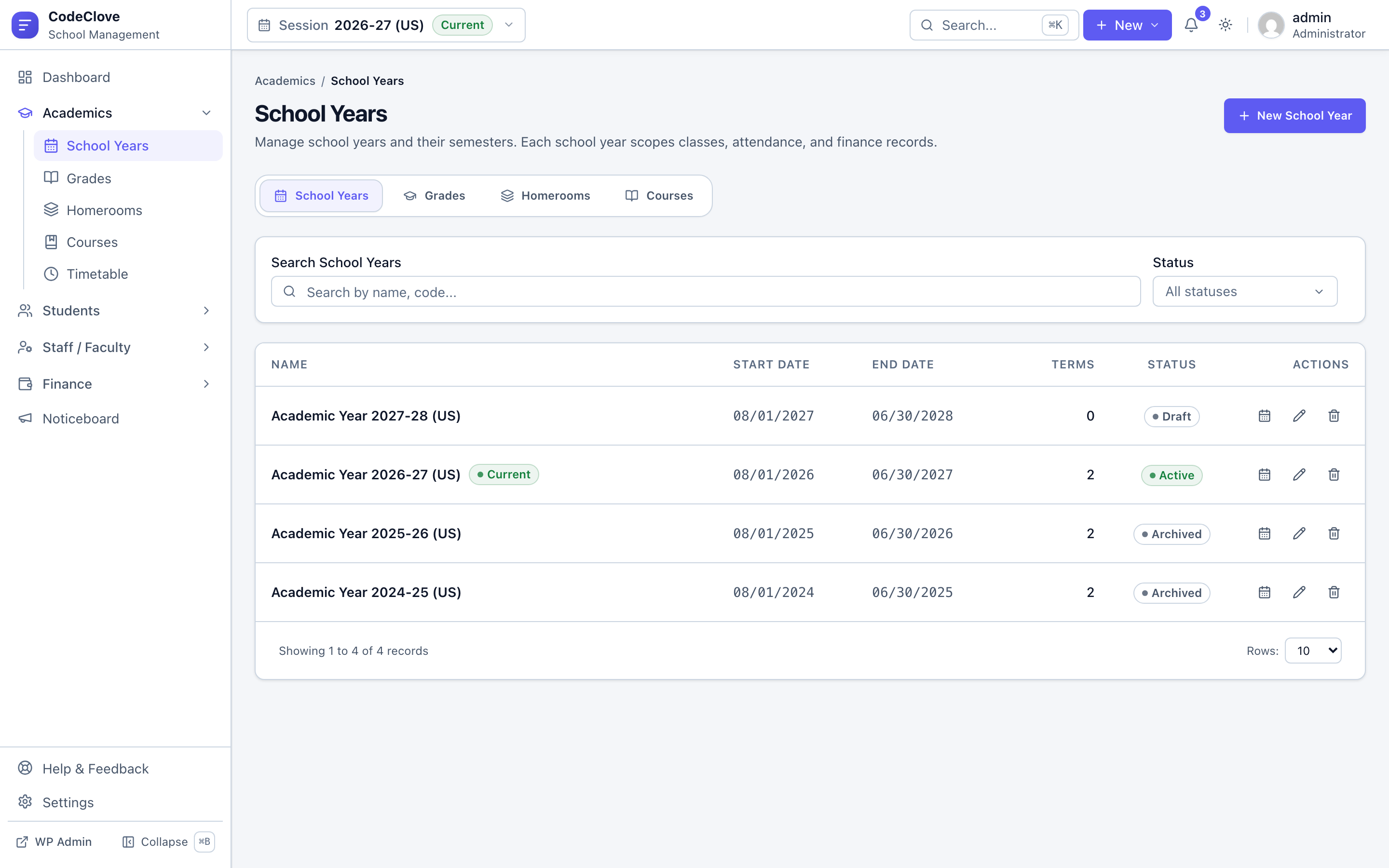
We built CodeClove School Management Pro with an India preset to eliminate setup friction. School administrators should never waste their opening week renaming database fields by hand. When you pick “India” during initial setup, CodeClove School Management Pro configures its terminology, fee rules, currency formatting, and notification channels to reflect how schools in India actually operate.
This guide explains what the India preset changes and how these settings support day-to-day administration across CBSE and ICSE campuses.
Classes and sections, not grades and streams
In an Indian school, a child belongs to Class 5, Section B. Nobody says Grade 5, Stream B. While this might look like a cosmetic detail, terminology matters. If a parent opens the portal and sees foreign labels, confusion follows. If a teacher rushes to complete morning roll call on an unfamiliar form, data entry errors happen.
Activating the India preset updates labels across the entire interface. Student rosters also connect directly to your online school admission pipeline using the [codeclove_admission_form] shortcode:
- “Grade” changes to “Class” throughout the admin screens, records, and guardian views.
- “Stream” changes to “Section” across student groupings.
- “Semester” changes to “Term”, matching the conventional Indian rhythm of Term 1, Term 2, and annual evaluations.
- “GPA” fields switch to percentage and marks displays that align with CBSE grading bands or ICSE mark sheets.
- “Homeroom teacher” changes to “Class teacher”.
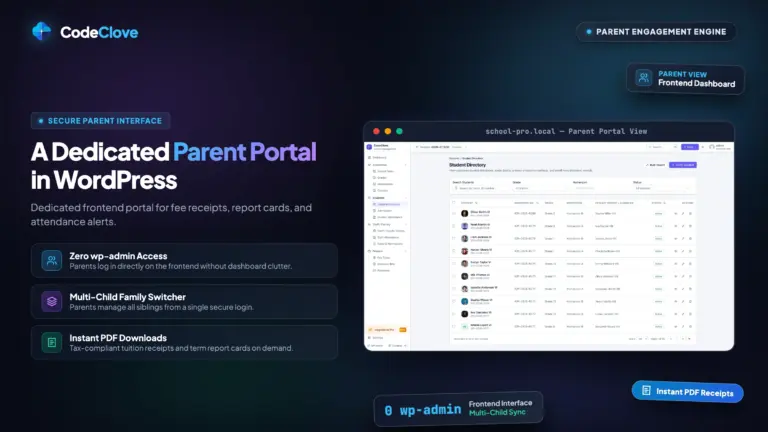
These labels appear consistently across the administrative dashboard, student profile records, printable ID cards, exported CSV reports, and the parent portal rendered by the [codeclove_portal] shortcode. You never have to edit code or rewrite language files.
CBSE and ICSE school structures
Indian schools under CBSE, ICSE, or State Boards share a familiar structural design. Education spans Nursery through Class 12, split into sections, operating on an academic year that runs from April to March.
CBSE schools guide students through foundational classes up to Class 10 Board exams, followed by Class 11 and 12 where pupils branch into Science, Commerce, or Humanities streams. The India preset sets up this baseline structure immediately, including upper-secondary stream choices.
ICSE institutions follow a matching progression, referring to Classes 11 and 12 as the Indian School Certificate or ISC division. Evaluation methods differ slightly between the councils. CBSE utilizes a 9-point positional grading scale from A1 down to E for secondary board results. ICSE records raw percentage marks alongside numerical subject points from 1 to 9.
| Operational Area | CBSE Schools | ICSE Schools | CodeClove School Management Implementation |
|---|---|---|---|
| Class Nomenclature | Classes 1 through 12, categorized into Primary, Middle, Secondary, and Senior Secondary | Classes 1 to 10 for ICSE, followed by Classes 11 and 12 for ISC | Preset unit hierarchies from Nursery, LKG, UKG up to Class 12 |
| Grading Framework | 9-point positional grading scale with grades from A1 and A2 down to E | Raw percentage marks with numerical subject scales from 1 to 9 | Flexible marks percentage calculation mode configured by default |
| Curriculum Splitting | Science, Commerce, and Humanities streams in Class 11 | Compulsory English combined with specialized subject combinations | Elective subject mapping and section-wise student distribution |
| Fee Schedules | Quarterly installments aligned with academic quarters | Term-based or monthly billing calendars | Configurable fee heads with itemized invoices and installment support |
The India preset configures class rosters, section groups, and three-term sessions immediately. Detailed CCE report card layouts and customized board transcript generators remain on our roadmap, while the current system manages daily marks recording, percentage totals, and student academic profiles.
INR currency and Indian fee structures
Schools in India rarely charge a flat, lump-sum tuition rate. A standard private school fee schedule breaks down into multiple itemized line items:
- Tuition fee billed quarterly or monthly
- Transport fee calculated by distance slabs, such as 0 to 5 km, 5 to 10 km, or beyond 10 km
- Computer lab fee billed annually
- Science laboratory fee for students in Class 6 and above
- Library charges and annual reading room access
- Annual development charges collected at the start of the session
- Examination charges billed prior to term assessments
The fee engine in CodeClove School Management Pro manages every charge through modular fee heads, as detailed in our guide to automated school fee collection with WordPress. The India preset seeds default fee heads common to CBSE and ICSE institutions. Administrators can adjust rates, introduce custom charges, and assign heads to target classes. A student in Class 2 skips the science lab fee. A child who walks to campus incurs zero transport charges.
Transactions run in Indian Rupees with the ₹ symbol across invoices. Number formatting uses the Indian numbering pattern, placing commas at thousand, lakh, and crore intervals so an amount displays as ₹1,25,000 rather than ₹125,000. When families request partial payments, the bursar can collect the tuition balance today and record the bus transport installment next month. The system maintains an itemized breakdown on every receipt, giving your finance desk exact visibility into unpaid heads.
Indian fee heads and payment reconciliation
Most Indian private schools continue to handle considerable offline volume through National Electronic Funds Transfer, Real Time Gross Settlement, account cheques, demand drafts, and physical cash. The built-in accounts ledger lets school staff log offline payments with cheque numbers, bank names, and transaction IDs. The ledger updates the student balance and produces a numbered receipt on the spot.
For online collections, CodeClove School Management Pro integrates directly with Razorpay, Stripe, and PayPal. For Indian institutions, Razorpay provides parent checkout through UPI apps including Google Pay, PhonePe, Paytm, and BHIM, alongside RuPay debit cards and NetBanking portals. When a parent clears dues inside the [codeclove_portal], automated webhooks reconcile the invoice instantly, eliminating manual receipt auditing at the front desk.
Indian SMS gateways: Fast2SMS and MSG91
SMS remains the primary operational communication channel for school parents in India. Push notifications and emails often get buried or ignored. Text messages arrive immediately on basic phones and smartphones alike.
Consider a CBSE school in Lucknow educating 1,500 students. The administration dispatches roughly 3,000 messages each week across morning absence notices, quarterly fee dues, exam dates, Parent-Teacher Meeting reminders, and urgent weather advisories. Routing those dispatches through international providers like Twilio costs roughly ₹3 to ₹4 per message, reaching ₹9,000 to ₹12,000 weekly. Using Fast2SMS or MSG91 drops that cost to roughly ₹0.18 to ₹0.25 per message, bringing the weekly bill down to ₹600 or ₹750.
That represents a saving of over ₹35,000 every single month for a mid-sized school.
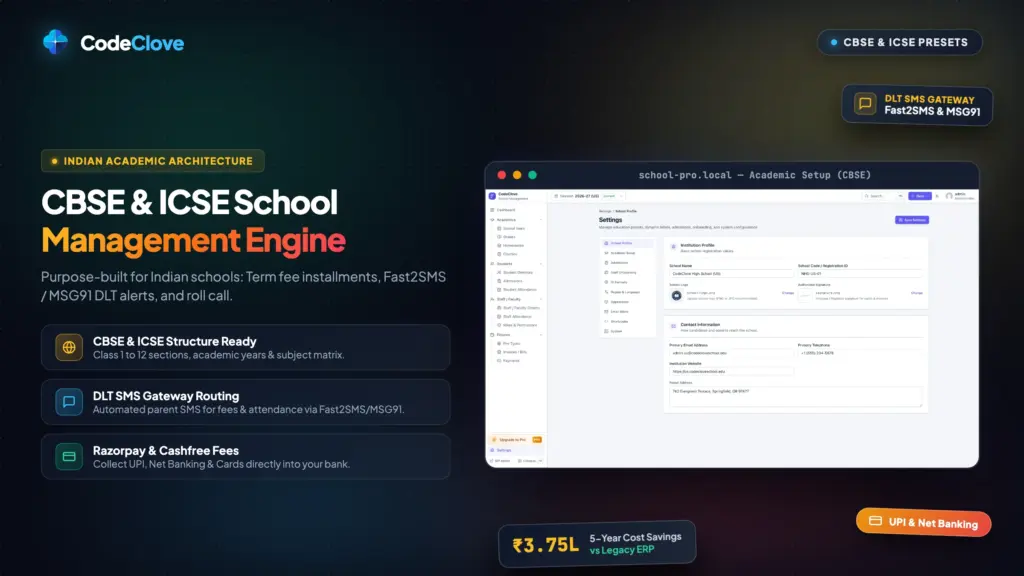
CodeClove School Management Pro integrates with both Fast2SMS and MSG91 out of the box. Adding your API key and Sender ID routes automated attendance warnings and payment notices through domestic Indian telecom channels at local transactional tariffs.
To comply with regulations from the Telecom Regulatory Authority of India, bulk messaging requires Distributed Ledger Technology registration. Your school registers as an enterprise entity with a telecom provider portal, uploads required message templates for attendance and fee notifications, and receives registered template IDs. You paste these approved template IDs into the plugin settings. From that point on, automated messages pass carrier filtering without interruption.
The academic calendar and Indian holidays
Schools in India structure their academic year from April through March, unlike the Western cycle starting in September. The India preset sets the school calendar to begin in April and conclude in March. It also populates gazetted Indian national holidays, including Republic Day, Independence Day, Gandhi Jayanti, Diwali, Eid, and Holi.
Administrators can add local state holidays or institutional events with a few clicks. The timetable builder integrates holiday calendars into class schedules so weekly session counts remain accurate.
Exam structures across CBSE and ICSE also differ from standard Western testing calendars. Schools run several distinct evaluation phases:
- Periodic tests conducted monthly or bi-monthly
- Half-yearly or mid-term examinations scheduled between September and October
- Annual final examinations scheduled across February and March
- Pre-board preparatory examinations for Classes 10 and 12 during December and January
The academic configuration in CodeClove School Management Pro supports these three-term splits. Teachers enter subject marks by section, calculate percentages, and keep a reliable historical record across the academic year.
Multi-branch network support for school chains
India hosts extensive school networks and educational trusts, including groups like DPS, DAV, Ryan International, and Cambridge Court. These organizations manage dozens of satellite campuses under a unified brand. Yet each branch requires its own CBSE or ICSE affiliation code, faculty directory, student registry, and fee collection accounts.
Using WordPress Multisite, a school society can operate independent subsites for each campus. Branch principals and accountants control local admissions and fee schedules independently. Central trust trustees access network-level oversight from a single WordPress network installation.
With more than 60 individual user permissions, the software maps directly to standard Indian staff roles: Principal, Vice Principal, Academic Coordinator, Section In-charge, Class Teacher, Subject Teacher, Bursar, and Transport Supervisor. Each team member views only the student records and financial tools necessary for their daily work.
Udyam registration: your school as a business entity
Educational societies, trusts, and private entities operating schools in India benefit from obtaining Udyam registration. Registration is free and completed online through the official Udyam Registration Portal under National Industrial Classification Division 85 for Education.
Holding an active Udyam certificate grants your institution access to priority sector lending and lower interest rates on loans for science labs or campus expansion. It also provides legal protection under the Micro, Small and Medium Enterprises Development Act against delayed payments from vendors and corporate partners.
Daily workflows with the India preset
Here is how a standard school day unfolds at a 1,200-student CBSE campus using CodeClove School Management Pro:
Morning at 8:00 AM: Class teachers take morning roll call on their mobile browsers or classroom tablets in under two minutes, as explained in our guide to attendance tracking for 1,000+ students. Parents of absent students receive an instant SMS through Fast2SMS or MSG91 stating: “Dear Parent, your ward Aryan Sharma of Class 7-B was marked absent on 05/09/2026. Please contact the school reception.” The alert conforms to your approved DLT template.
Mid-morning at 10:00 AM: The bursar office filters fee records to generate second-quarter reminders. Parents with unpaid balances receive an automated SMS containing their outstanding amount and a direct URL to review their invoice inside the parent portal.
Afternoon at 1:00 PM: The Academic Coordinator receives notice that a Mathematics teacher for Classes 9 and 10 has taken urgent sick leave. Opening the timetable scheduler, the built-in substitution tool identifies a colleague who teaches middle school math and holds a free period during Class 9-A. With two clicks, the coordinator assigns the substitution and sends a notification to the teacher.
End of day at 3:30 PM: The principal opens the executive dashboard. In 30 seconds, they check total campus attendance, confirm ₹2,45,000 in fee receipts collected across UPI and bank transfers during the day, and approve three new student applications submitted through the online admission form.
The entire workflow runs inside your own WordPress installation. No third-party SaaS dashboards, no disconnected spreadsheets, and no monthly per-student billing penalties.
Setting up CodeClove School Management Pro for an Indian school
Setting up a campus takes about an hour on standard hosting. Here is the operational checklist:
- Set up WordPress on your server. Quality managed hosting or an Indian cloud VPS located in Bangalore or Mumbai provides rapid response times for local parents.
- Install the free CodeClove School Management plugin from WordPress.org, then activate CodeClove School Management Pro to unlock online payments, SMS drivers, and timetable tools.
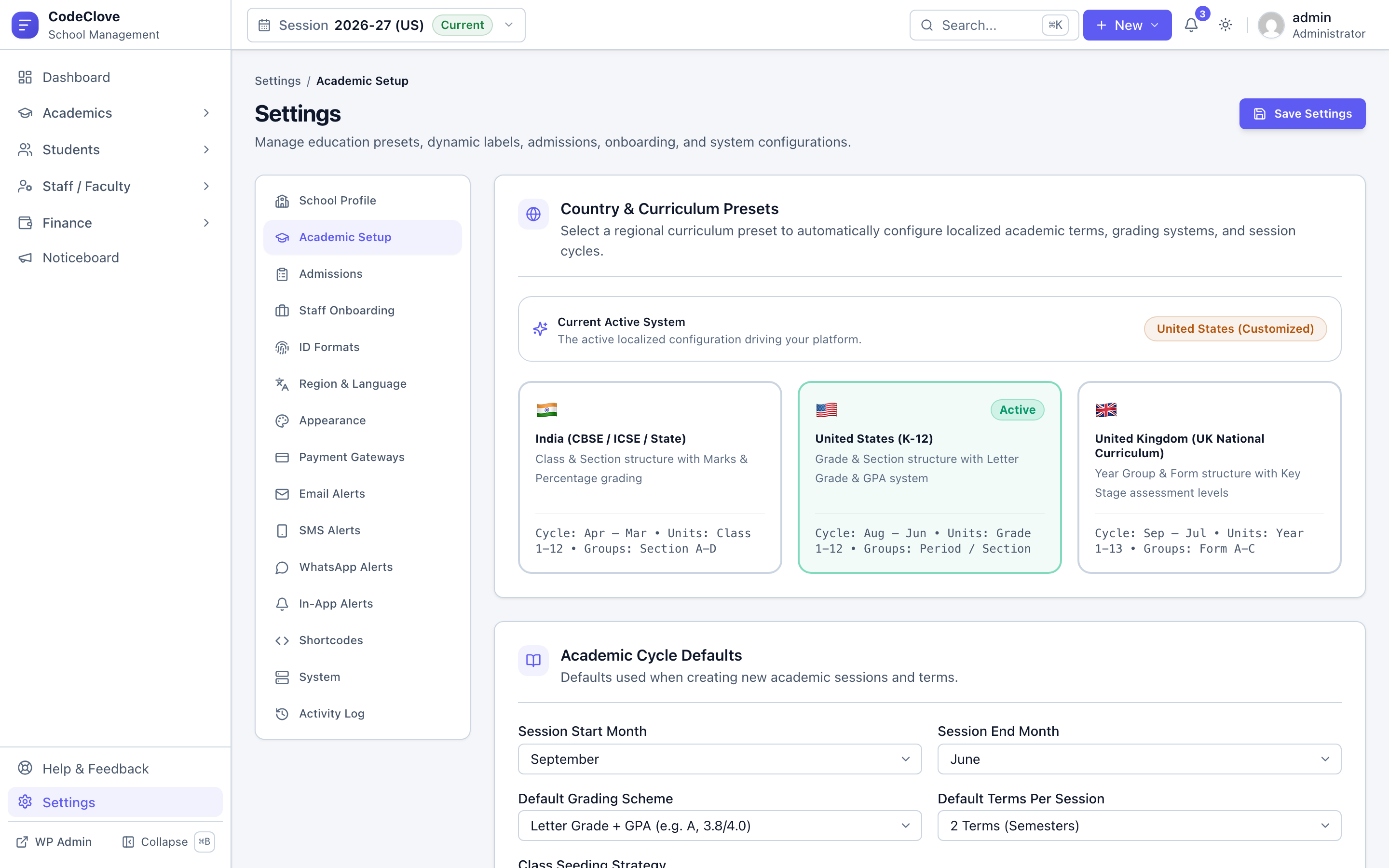
- Open the setup wizard and choose India as your country preset.
- Enter your school identity details, including campus name, CBSE or ICSE affiliation number, and the April to March academic year.
- Review the generated classes and sections. The preset seeds Nursery through Class 12 with sections A through D. Adjust or remove sections according to your campus enrollment.
- Define your fee heads, assigning tuition, laboratory, and transport charges to matching class levels.
- Connect your Fast2SMS or MSG91 API credentials and enter your approved DLT Sender ID.
- Configure Razorpay with your key ID and secret to enable instant UPI and RuPay fee payments.
- Publish a page with the
[codeclove_portal]shortcode so parents and pupils can inspect grades, attendance, and fee receipts, following our tutorial on building a WordPress parent portal. - Add your student directory and teaching staff through the bulk CSV spreadsheet importer.
Once completed, your campus management infrastructure is fully operational. The core CodeClove School Management plugin is available free on WordPress.org. A CodeClove School Management Pro license begins at $59 for a single site, $109 for five sites, and $179 for unlimited sites. Each license grants one year of updates and support with zero per-student subscription fees.
You can test the full administrative interface and parent experience right now in our live interactive sandbox.
Frequently asked questions about Indian school management in WordPress
Does CodeClove School Management Pro support the Indian April to March academic calendar?
Yes. The India preset aligns session dates, terms, quarterly fee intervals, and holiday schedules to the standard April to March academic cycle observed by CBSE, ICSE, and state education boards.
Which SMS gateways work best for Indian schools?
CodeClove School Management Pro includes native drivers for Fast2SMS and MSG91 alongside international options like Twilio and Vonage. Connecting your provider API key and Sender ID delivers absence alerts and school circulars at domestic Indian transactional rates of roughly ₹0.18 to ₹0.25 per message.
Can parents pay fees using UPI apps like PhonePe, Google Pay, and Paytm?
Yes. CodeClove School Management Pro integrates with Razorpay, allowing parents to settle invoices directly using UPI apps such as PhonePe, Google Pay, Paytm, and BHIM, as well as RuPay cards and NetBanking. Once payment succeeds, the system updates the student ledger and marks the invoice paid automatically.
How does the plugin handle TRAI DLT compliance for school messages?
The plugin allows you to input your registered DLT Entity ID, Header, and specific Template IDs for each alert type. As long as your message text matches the template approved on your telecom provider portal, all SMS notifications deliver reliably without carrier rejection.
Can school chains run multiple branches from one WordPress installation?
Yes. Using WordPress Multisite, educational societies can configure individual subsites for separate branches. Each campus retains its own CBSE affiliation number, fee structure, and student records, while society leaders retain centralized administrative oversight.
A system that matches how Indian schools work
The mismatch between typical school administrative tools and Indian campus realities creates daily friction. Teachers should not have to interpret foreign terminology during morning attendance. Parents should never see foreign currency symbols on school fee slips. And school trusts should not pay exorbitant international tariffs for simple text alerts when local SMS gateways cost a fraction of the price.
CodeClove School Management Pro bridges this gap. Its India preset configures classroom terminology, Indian Rupee formatting, local SMS connectivity, multi-installment fee heads, and an April to March session calendar right out of the box.
If you run a CBSE, ICSE, or state board school and want an administrative platform that respects how Indian institutions actually function, get started with CodeClove School Management Pro. You can also begin with the free edition of CodeClove School Management on WordPress.org or explore our live interactive sandbox to experience the India preset in action.